What a Casino Game Turn Is Built to Do
A casino game turn makes control, choices, and handoffs visible, helping technical education students explain a game’s procedure without implying its next result.
The most common mistake in teaching a casino game turn is to present it as a string of button presses or card movements. Students may memorize the order but still miss who controls each moment, and they may mistake procedure for a prediction of what comes next.
For technical teacher education, a casino game turn is a compact way to study how interface cues, player decisions, and automatic procedures fit together. Keep the design question concrete: what does the player need to understand now, and what should the screen make visible?
What should a casino game turn communicate?
Show three things: the current game state, the decision or procedure active now, and the event that moves play forward. This makes the turn understandable without suggesting that its sequence determines a future result.
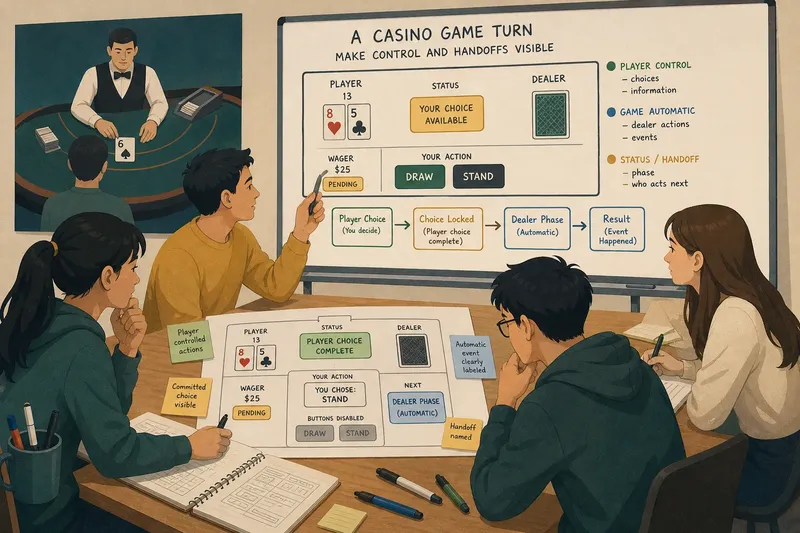
A table interface, for instance, could label a wager as pending, mark a player choice as available, and identify a dealer action as automatic. Use distinct labels, prompts, or visual treatments so learners can see who controls each part and when control changes.
How do player-led, game-led, and hybrid turns differ?
In a player-led turn, the game presents information and waits for the player to choose before resolving that part of play. A blackjack-style choice to draw or stand illustrates the structure: the player sees the options, commits to one, and the interface proceeds.
A game-led turn begins with an automatic event, such as a reveal, that establishes the current situation. The player may respond, or the game may settle the result without another choice. Teach students to distinguish information supplied by the game from actions controlled by the player.
A hybrid turn alternates between those roles. A card-game interface might reveal a card, invite a player decision, and then apply a dealer procedure. Give each handoff a recognizable cue so learners can tell when the player’s role begins and ends.
Choose the structure that reflects the game’s actual division of control.
How can a lesson make control and feedback visible?
Start with a small interface sketch on paper or a whiteboard. Draw a player area, a dealer area, and a status area; label which information belongs in each, then use different visual treatments for player-controlled choices and automatic game events.
- Available choice: Check whether the player can see the available action and the information needed to choose. If both are visible, keep the prompt; if either is missing, add it or explain why the game is waiting.
- Committed choice: Check whether the selected action remains visible after selection. If it does, disable the alternatives; if it does not, show the committed action before advancing.
- Automatic event: Check whether an event performed by the game is distinguishable from a player command. If it is, retain the cue; if it is not, add a label or separate visual treatment.
- Control handoff: Check whether the interface names the next actor or phase. If it does, keep that cue; if it does not, add a prompt or phase label and show the current actor’s options.
- Result wording: Check whether a message reports an event that already happened or implies that it predicts another. If it reports the past, keep the factual wording; if it suggests prediction, rewrite it to describe only the completed event.
- Next action: Check whether the player can tell what to do after the current event. If play continues, show the available action; if the turn has ended, state that clearly instead.
These checks turn interface analysis into specific design decisions while keeping the exercise focused on communication, not forecasts.
What does a worked classroom design exercise look like?
Imagine a fictional teaching prototype with one player hand, one dealer hand, and two buttons labeled “draw” and “stand.” Its invented starting state has both buttons visible, but the screen gives no indication of what happens after either choice.
Students first label “draw” and “stand” as player-controlled actions and the dealer’s later reveal as automatic. They then revise the screen so either selection displays the chosen action, disables both buttons, and shows “Player choice complete.” Finally, they add a separate “Dealer phase” label before the automatic reveal.
The expected observable result is that a learner can identify the player’s decision, see that the choice is closed, and recognize the dealer’s action as automatic. The prototype clarifies the procedure without making a claim about what a future hand will contain.
What questions help students analyze a casino game turn?
How is a turn different from a round?
A turn is a local unit of play, often centered on an action or decision. A round can include several turns or phases before play advances or resets; define both terms according to the specific game.
How should an interface show that a choice has closed?
Show the committed selection, disable or remove the alternatives, and indicate the next phase. Do not rely only on a sound or a subtle color shift that a player could miss.
Does a game’s action order predict its next result?
No. The order explains how the current procedure works, not what a later result will be. Keep explanations of rules separate from claims about likelihood or prediction.
What belongs in a prompt during play?
Show the immediate choice and the information needed to make it, then place secondary rules nearby. If exceptions crowd the prompt, separate them so the current action stays easy to find.
How can teachers adapt the exercise to different learning goals?
If students are learning to distinguish player control from automatic action, have them mark those elements on the interface sketch. For a visual-communication lesson, ask them to compare labels, button states, and phase cues, then revise one cue that could be misread.
For a technical-documentation lesson, ask each student to explain the fictional prototype’s player decision and automatic dealer phase. A peer should be able to match each sentence to a visible screen element; if not, revise the wording or the interface.
A useful review question is simple: can the player identify the current action and who controls it? If the answer is unclear, revise the cue at that moment rather than adding more explanation elsewhere.