A Rainy-Afternoon Casino Game Design Study With Paper Components
A rainy-afternoon casino game design study turns paper, tokens, and a focused classroom challenge into a hands-on lesson in iteration and design choices.
The common mistake in a rainy-afternoon casino game design study is to copy a familiar game before deciding what students should learn. That can leave a class sorting pieces without making a meaningful design choice. Start with a small paper prototype and a clear challenge: make a casino-inspired game easier to understand without using money or requiring knowledge of gambling rules.
What should students make during a rainy-afternoon casino game design study?
Set out index cards, blank paper, pencils, colored tokens, and a die. Ask students to create a simple turn-based game in which a player chooses a token, places it in a marked area, and sees an outcome determined by the die. The goal is to study how choices, components, and instructions fit together—not to recreate a real-money game.
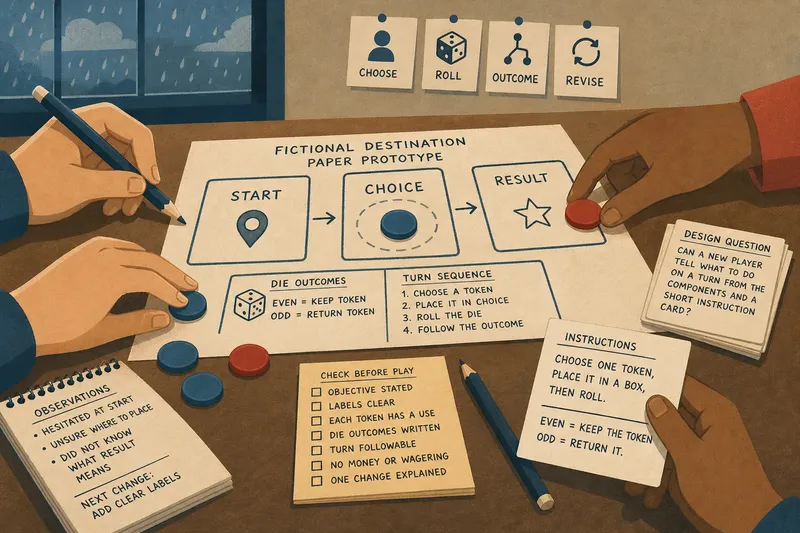
Give the class one design question to guide the work: can a new player tell what to do on a turn from the components and a short instruction card? This shifts attention from copying a casino table to solving a teachable problem in communication and prototyping.
Keep the activity on paper, and make participation about design decisions rather than wagering or predicting outcomes.
How do you set up a playable paper prototype?
Draw a playing area on a sheet of paper and divide it into a few clearly labeled spaces. Use colored tokens to represent player choices and a die to produce an outcome; write down what each outcome means before anyone begins.
Give the prototype a neutral theme, such as a museum exhibit or a fictional destination, while discussing casino-game design as the reference point. That lets students examine familiar design features—marked zones, tokens, turns, and chance—without imitating betting.
Make only enough rules to support a short demonstration. If a player cannot tell where a token goes or what the die result means, pause and revise the component or instruction instead of adding more rules.
How can students improve the design through iteration?
Have one student explain the prototype while another follows the instructions without coaching. The listener should point to the space for a choice, identify when to roll, and explain what the outcome means. Note each hesitation as a specific design question.
Then make one visible change at a time: enlarge a label, move a marked space, change a token color, or rewrite a confusing instruction. Repeat the explanation and decide whether the change made the intended action easier to identify. Treat this as classroom observation, not evidence of a universal result.
Say a team starts with a sheet containing three unlabeled boxes, two blue tokens, one red token, and a die. They write “choose one token, place it in a box, then roll” on an index card, and assign the die’s even results to “keep the token” and odd results to “return it.” During the first explanation, the listener cannot tell which box is the starting space. The team labels the boxes “start,” “choice,” and “result,” then asks the listener to follow the same card again; if the listener can point to each named space in sequence, the team keeps the labels, and if not, it changes the wording or layout again.
What should you check before calling the prototype ready?
- Check whether the objective is stated on the instruction card; if a reader can say what the design task is, keep the wording, but if the objective is missing or vague, rewrite it before play.
- Check whether every paper space has a readable label; if a student can match each label to the intended action, keep the layout, but if two spaces are easy to confuse, rename or reposition them.
- Check whether each token has one stated use; if a player can explain what a token represents, keep it, but if its role is unclear, add a label or remove that token.
- Check whether the die outcomes have a written meaning; if each possible face is accounted for in the rules, use the die, but if any result has no instruction, revise the outcome list before play.
- Check whether a learner can follow the turn without spoken hints; if the learner completes the written sequence, keep the instructions, but if a hint is needed, revise the line where the learner paused.
- Check whether the activity uses money, prizes, or wagering; if it does, replace that element with points used only for discussion or remove it, and if it does not, explain the classroom design goal before students start.
- Check whether students can explain one change they made; if they can connect the change to a specific confusion, record that design reason, but if they cannot, ask them to identify the observed difficulty before making another revision.
What skills can the activity teach future technical educators?
The prototype gives future teachers a compact way to practice explaining a system, observing where a learner gets stuck, and revising materials in response. Those are useful skills for designing a classroom demonstration or technical instruction sheet, where labels and sequence can affect whether a task is understood.
Ask students to describe the difference between a rule and a design choice. “Roll the die after placing a token” is a rule in their prototype; “use a larger label for the choice area” is a design decision. Separating the two helps the class discuss how an activity works and how its presentation might change.
Keep notes focused on observable moments: a learner points to the wrong space, asks what a token means, or completes the turn from the card. Avoid treating one student’s response as proof that the design will work for every class.
Which classroom questions help refine the prototype?
What materials are enough to start?
Use paper, index cards, pencils, colored tokens, and a die. If a component cannot be explained in plain language, leave it out until the design needs it.
How can the activity stay separate from gambling?
Use no money, betting, or real-world wagering, and frame the task as a design exercise. Discuss turns, choices, chance, and clear instructions through a fictional paper game.
What should students do when a rule is unclear?
Pause the activity and identify the exact moment where the instructions stop guiding the player. Revise that line or component, then have someone follow the revised version without coaching.
How should a team decide which revision to keep?
Keep a change when it addresses a specific observed confusion and the next reader can follow the intended action from the materials. If the confusion remains, revise again rather than adding an explanation that only the designer knows.
How should you preserve the design work?
Save the paper layout, instruction card, and a short note naming the design question. Record one confusing moment and the change made in response, so another instructor can see how the prototype developed without mistaking it for a finished game.
For a rainy-afternoon casino game design study, the most useful record is not a polished imitation of a casino table. It is a small, playable paper prototype that makes each design decision visible and gives students a concrete reason to revise it.