How to Design a Casino Game Rule Card for the Table
Design a casino game rule card that players can scan quickly, with clear actions, readable type, and a precise pointer to full rules when needed.
The most common design mistake on a casino game rule card is shrinking every sentence until the card fits, then expecting players to find the important action at a glance. The result is a crowded surface that slows decisions and makes essential wording easy to miss. A better card gives the main task visual priority and treats the remaining space as a design constraint.
For technical teacher education at Trường Đại học Sư phạm Kỹ thuật Vinh, this is a useful exercise in information design: students can turn a dense set of instructions into a compact, usable object. The work is not to rewrite the whole game. It is to choose what belongs on the card, arrange it for quick scanning, and direct readers to supporting material when they need more detail.
What should a casino game rule card help players do?
Start by naming the moment the card supports. A table reference might help a player compare options, check a payout, or recall a condition. Trying to serve all of those purposes equally often produces a card with no clear visual path.
Write a one-sentence purpose for the card before laying it out. If the purpose is to help a reader locate a specific decision, make that decision prominent; put secondary explanations and references in supporting positions.
How do you organize the information?
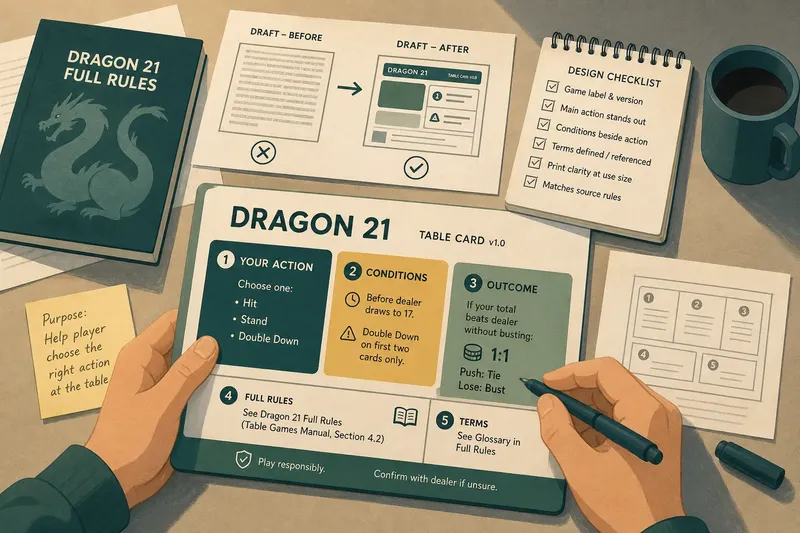
Group related content so a reader can scan by task instead of reading every line from top to bottom. Use plain labels, consistent alignment, and a clear distinction between the action, its condition, and any result stated on the card.
- Game identity: Name the game and version the card covers.
- Player action: State the choice or procedure the card is meant to support.
- Condition: Place timing limits or exceptions next to the action they affect.
- Outcome: Show a payout or result only when the applicable rule material supports it.
- Further reference: Point clearly to the matching full rules or table instructions.
- Verification: Compare every statement with the source material for the same version before approving the layout.
For each item, check whether it is accurate and easy to locate. If the wording is supported and visible, keep it; if it is uncertain, verify it before printing; if it does not serve the card’s purpose, move it to the supporting material.
How can you make the card easier to scan?
Establish a visual hierarchy before adjusting individual words. Use a prominent game label, a readable body style, and spacing that separates one decision from another. Avoid relying on color alone to distinguish conditions; labels and grouping should still make sense in a plain print or photocopy.
Imagine a student is given an invented card draft with three blocks: a game name, a player action, and a long paragraph of exceptions. The student moves the action into a clearly labeled block, places the conditions beside it, and sends detailed procedures to a named full-rules document. The expected result is that a reader can find the relevant action sooner while retaining a clear route to the supporting explanation.
Print a draft at its intended use size and inspect it from the position where a reader would consult it. If labels blur or sections merge, simplify the wording or rearrange the layout before reducing text size further.
What should stay on the card, and what belongs elsewhere?
Keep information that directly supports the card’s stated purpose. Move lengthy definitions, uncommon edge cases, and detailed dispute procedures to the full rules when the card can point to that material clearly.
Do not make a short label carry meaning that the source material does not establish. If an essential term needs explanation, define it briefly on the card or provide a specific reference. If neither option fits, revise the card’s scope so readers are not left with a misleading instruction.
When the card and supporting rules appear inconsistent, check that they cover the same game version and table procedure. If the conflict remains, pause publication and ask the responsible instructor, venue representative, or game authority to resolve it.
Which card-design questions should you check?
How much text should a card contain?
Include enough to support the card’s stated task, not every detail in the game. If readers need a longer explanation, point them to the corresponding full rules rather than crowding the reference.
Should color carry the meaning of a condition?
Use color as a visual aid, not as the sole signal. Pair it with words, symbols, or grouping so the distinction remains clear in a monochrome copy.
Where should a reference to full rules appear?
Place it near the content that may require more detail, and identify the matching document or location plainly. A vague direction such as “see rules” gives readers little help finding the right source.
How can a teacher assess a draft?
Give students the source rules and ask them to build a card for one specific table task. Review whether each statement matches the source, whether the intended action stands out, and whether a reader can locate further material when needed.
How can you review a draft before using it?
Use a short review that connects each observation to a decision:
- Game label: Check that the game and version are identified; if both match the source material, retain the label, but if either is unclear, verify it before use.
- Main action: Check that the intended player choice is easy to locate; if it stands out, keep the hierarchy, but if it blends into other text, rearrange the section.
- Conditions: Check that each limit sits beside the action it affects; if the relationship is clear, retain it, but if readers could attach it to another action, rewrite or regroup it.
- Terms: Check whether specialized words are defined or referenced; if readers can find the meaning, keep the wording, but if not, add a concise definition or a precise source pointer.
- Print clarity: Check the draft at its intended use size; if text and labels remain legible, proceed to content review, but if they blur, simplify or redesign rather than crowding them further.
- Source match: Check each instruction against the rules for the same version; if they agree, approve that wording, but if they conflict, hold the draft and seek clarification.
How does the design process work in practice?
Say a class receives an invented source packet containing a game name, a player action, one condition attached to that action, and a separate page of detailed procedures. The assignment is to make a table card that helps readers locate the action without replacing the source packet.
- Write the card’s purpose as “help the reader locate this player action.”
- Place the game name and version at the top so the card’s scope is visible.
- Put the action in the main text area and attach its stated condition directly beneath it.
- Move the detailed procedures to a supporting reference and name that reference on the card.
- Print the draft at its intended use size and ask a classmate to locate the action and the supporting document.
- If the classmate finds both without confusing the condition, keep the arrangement; if not, revise the hierarchy or reference wording and check again.
The resulting tradeoff is deliberate: the card does not reproduce the full procedures, but it makes its central task easier to identify and gives the reader a specific route to more detail.
What makes a casino game rule card useful?
A useful casino game rule card connects a clear purpose to a readable layout. It gives the main task visual priority, keeps related conditions close, and points to supporting rules with enough detail for a reader to find them.
Use “casino game rule card” as the design brief’s central phrase, then test the draft against its actual job: can a reader locate the intended action, understand how its stated condition attaches, and find the named source for more detail? If any answer is no, revise that part before the card reaches the table.